Description
Introduction
by Shaykh Dr. Abdalqadir as-Sufi
This introduction from the first edition has been restored in the forthcoming 3rd edition.
Several years ago during the Visit in Madinah I visited the quarter of the bookshops. While browsing, I suddenly became aware of a group of young men who were grabbing copies of one edition with such speed and excitement that I saw it disappearing before my eyes. So intrigued was I that I took a copy myself and bought it at the same time. For I quickly realised that the work which had caused such a commotion was not only an Islamic classic but an important work by one of the Imams of the Muslims and one of the leaders among the masters of the School of the People of Madinah, Qadi Abu Bakr ibn al-‘Arabi of Seville. Not only that but the work could be considered the definitive statement on the distressing issue of the great primal fitna at the time of the Kaliphate. The clarity of the notes in the Arabic edition seemed almost as important as the text itself. Since the notes were necessary for the clarification of this work, which was written in 536 Hijra, I decided to unify the two parts of the book into one continuous text, differentiating Qadi Abu Bakr’s statements from his modern editor’s comments by the simple expedient of a distinguishing typeface, while leaving the enumeration of the notes to allow easy access.
Qadi Abu Bakr was born in Seville, Andalucia in 468 Hijra. He travelled extensively in the Muslim world, and studied in Baghdad. Although one of the leaders of the fuqaha’ of the Murabitun and a supporter of Yusuf ibn Tashfin, he met Abu Hamid al-Ghazali both in Baghdad and in the Syrian deserts. On his return from the Hajj he settled in Seville. Great Islamic scholars studied under him including Shaykh al-Islam, Qadi ‘Iyad ibn Musa, the author of Ash-Shifa’. At one point in his work as Qadi he led the community in working to restore the safety of the wall around Seville. As a result of this he created enemies who stirred people up against him with slander until he was besieged in his own house in the same way as Amir al-Mu’minin ‘Uthman ibn ‘Affan had been when the rebels attacked his house.
His most famous book is his Ahkam al-Qur’an which remains one of the great source-books on the legal judgments of the Qur’an. Another work, an-Nasikh wa’l-Mansukh fi’l-Qur’an, is considered the most correct on the subject. The Qadi was buried in Fes in 543 Hijra, may Allah have mercy on him. The title of the present book in Arabic is al-‘Awasim min al-Qawasim which means ‘The defences or protections from disasters’, however the singular is more appropriate in the English language, and the book itself is that defence.
The significance of the events laid out in this great text are of enormous importance to all the Muslims, not only because of the nature of the crisis, and of the elevated spiritual status of the people involved, but because of the historical resonance of these events. The innovation of the Shi’a politique, coming as it does after the age of the Khulafa al-Rashidun is nevertheless inextricably bound up with the end of rule from Madinah. It is a doctrine which structurally seems to evolve through three phases. One, the claim that the fourth Kaliph, ‘Ali should have been the immediate successor in power and not the fourth in line. Two, the claim of injustice in the events that led to Mu’awiya assuming power. Three, the emergence of a series of martyred descendants whose twelfth member went into miraculous suspended existence in the Unseen with a promise to appear at the end of time. That twelve generations should fail to assume the power they claimed was theirs suggests their lives were based on unsound foundations.
As the descendant of a leading Jacobite warrior who died at Culloden in the attempt to restore Charles Stuart to the Scottish throne, I can directly intuit the danger of living in the darkness of a lost leader. After the defeat of Bonny Prince Charlie, the Jacobites, knowing they had irrevocably lost, began to dream of his return. The people sang, “Will ye no’ come back again”. There is a world of lamentation for dead martyrs, for a lost way of life, and for a lost leader, and it can quickly be given metaphysical status. In politics the crucial issue is the taking of power and the wielding of power. It is on that basis that the just or the unjust society is achieved. The moment a people turn to lamentation, denounce the rulers as unjust and evil, and await a miraculous delivery by an absent leader, a tragic, psychological dislocation has taken place. If the people of power are evil that becomes your licence to claim that you are good. The act of denouncing others, far from being a path to social renewal, is a path to psychological breakdown. More profoundly, it is a failure to recognise and accept the Decree of Allah, glory be to Him. For the establishment of the just in power and the sweeping away of injustice itself cannot be established once your reason for living is your lament at the presence of injustice and your tear-filled cry that the good leader has still to come. All this implies that the religion is not complete, and ironically, will only be completed at the end of time, when in fact, that surely is too late for things to be put right. The message of this great book seems to be that of course things came about as they had to come about, and in it there was a great glory for the protagonists, and at the heart of the affair, there is no one worth waiting for. There is no need to live in hope of one who will come. It is the utmost ignorance to imagine it. He already came. He was the first of the sons of Adam, and he said that without boasting. And Allah, The Exalted, has told us: “Certainly, there has come from among you, a Messenger. He is concerned about you, and with the Believers he is gentle and compassionate.” Who could ask for anything more?
Shaykh Dr. Abdalqadir as-Sufi
Achnagairn,
Scotland
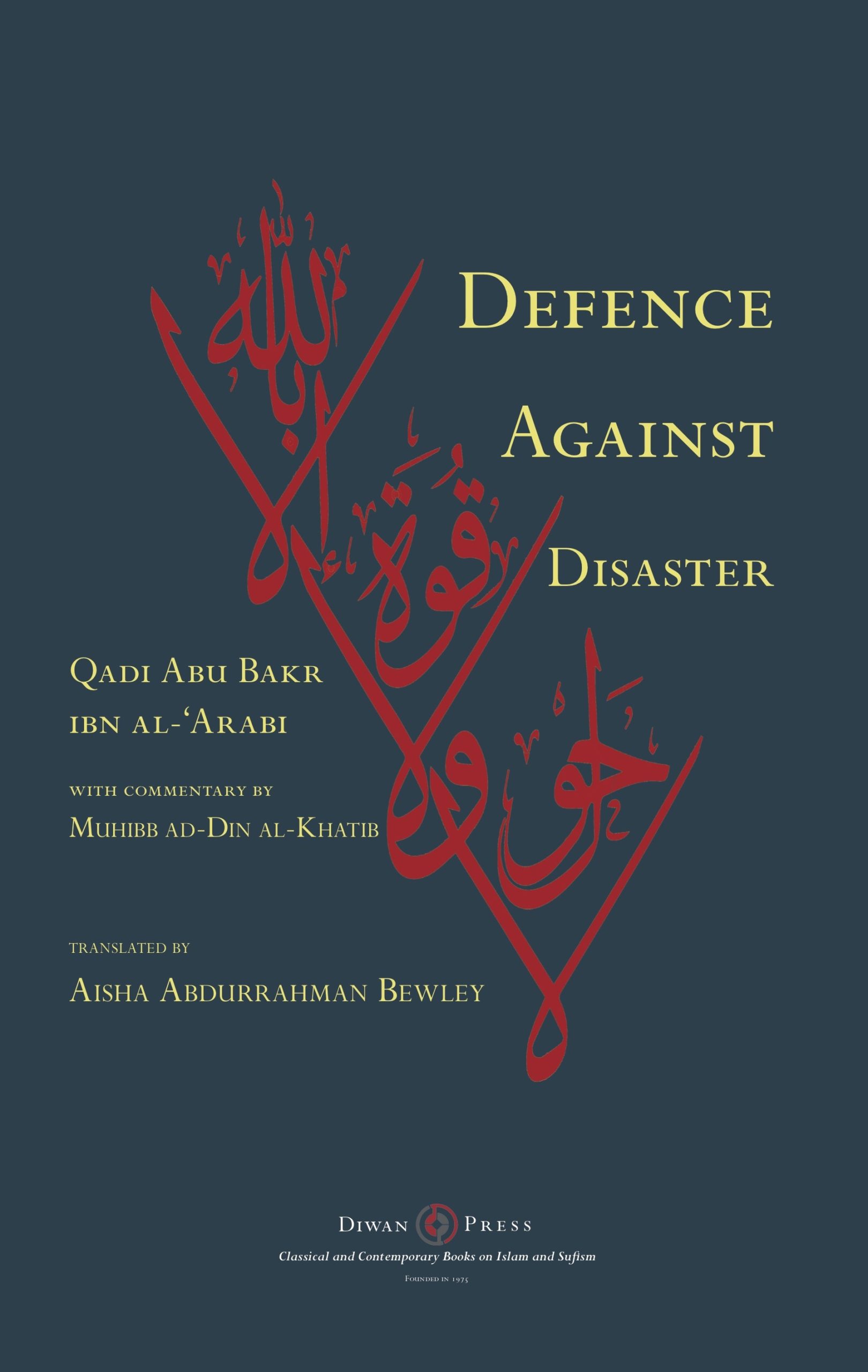
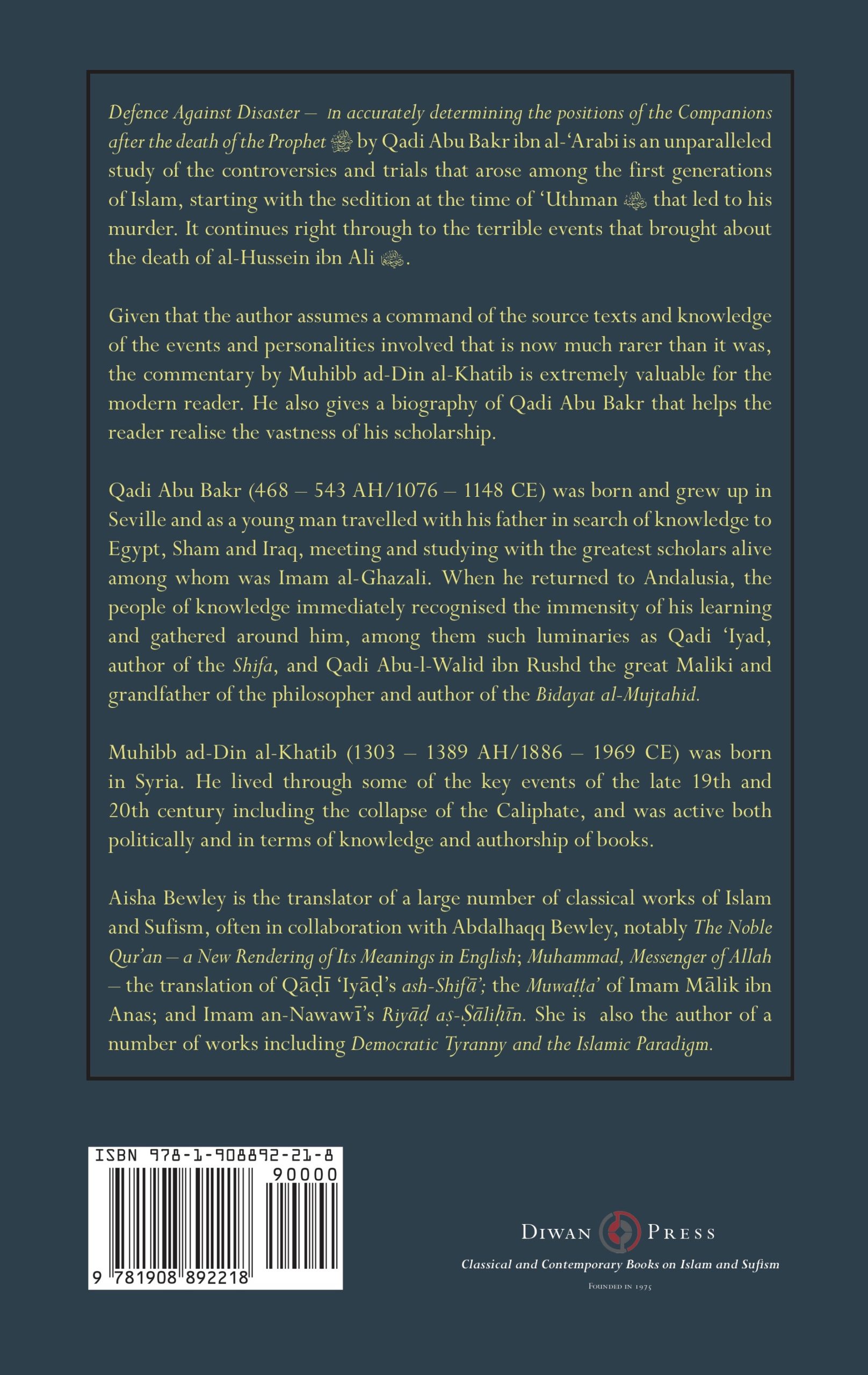
Defence Against Disaster – in accurately determining the positions of the Companions after the death of the Prophet, may Allah bless him and grant him peace, by Qadi Abu Bakr ibn al-‘Arabi is an unparalleled study of the controversies and trials that arose among the first generations of Islam, starting with the sedition at the time of ‘Uthman, may Allah be pleased with him, that led to his murder. It continues right through to the terrible events that brought about the death of al-Husayn ibn ‘Ali, may Allah be pleased with him. In the process the author responds with expert critical analysis of the chains of narration of the hadith and traditions pertaining to these events, and defends all of the Companions from the multiple defamations against many of them.
Fatefully, the tradition of Muslim writing and compilation of books began after the time of the Abbasid coup (dawla) and overthrow of the Umayyads, a coup which necessarily entailed the Umayyads being cast as THE villains of Muslim history. Some Abbasid-era historians and later incautious scholars were to set this in concrete as if it were almost a consensus, which has lasted right until our day.
In this work, Qadi Abu Bakr and his commentator Muhibb ad-Din al-Khatib do not recast the Abbasids as the villains, nor are they anti-Alid or pro-Umayyad, as some of the Qadi’s less discerning critics have alleged, but rather they restore to us the continuity of those early years from the time of the Rightly Guided Caliphs through the epoch of the early Umayyads, in the process doing full justice to the Companions, particularly the Four Caliphs, and al-Hasan, Mu’awiya, al-Husayn, Ibn ‘Umar, and Ibn ‘Abbas, may Allah be pleased with them, and refuting slanderous allegations against them individually and as a body.
In our need during this Great Interregnum, after the collapse of the Ottoman polity, to go right back to the roots, the very beginnings in Madina al-Munawwara, and to retrace our story from there to today, this book stands uniquely well placed for that purpose.
Given that the author assumes a command of the source texts and knowledge of the events and personalities involved that is now much rarer than it was, the commentary by Muhibb ad-Din al-Khatib is extremely valuable for the modern reader. He also gives a biography of Qadi Abu Bakr that helps the reader realise the vastness of his scholarship.
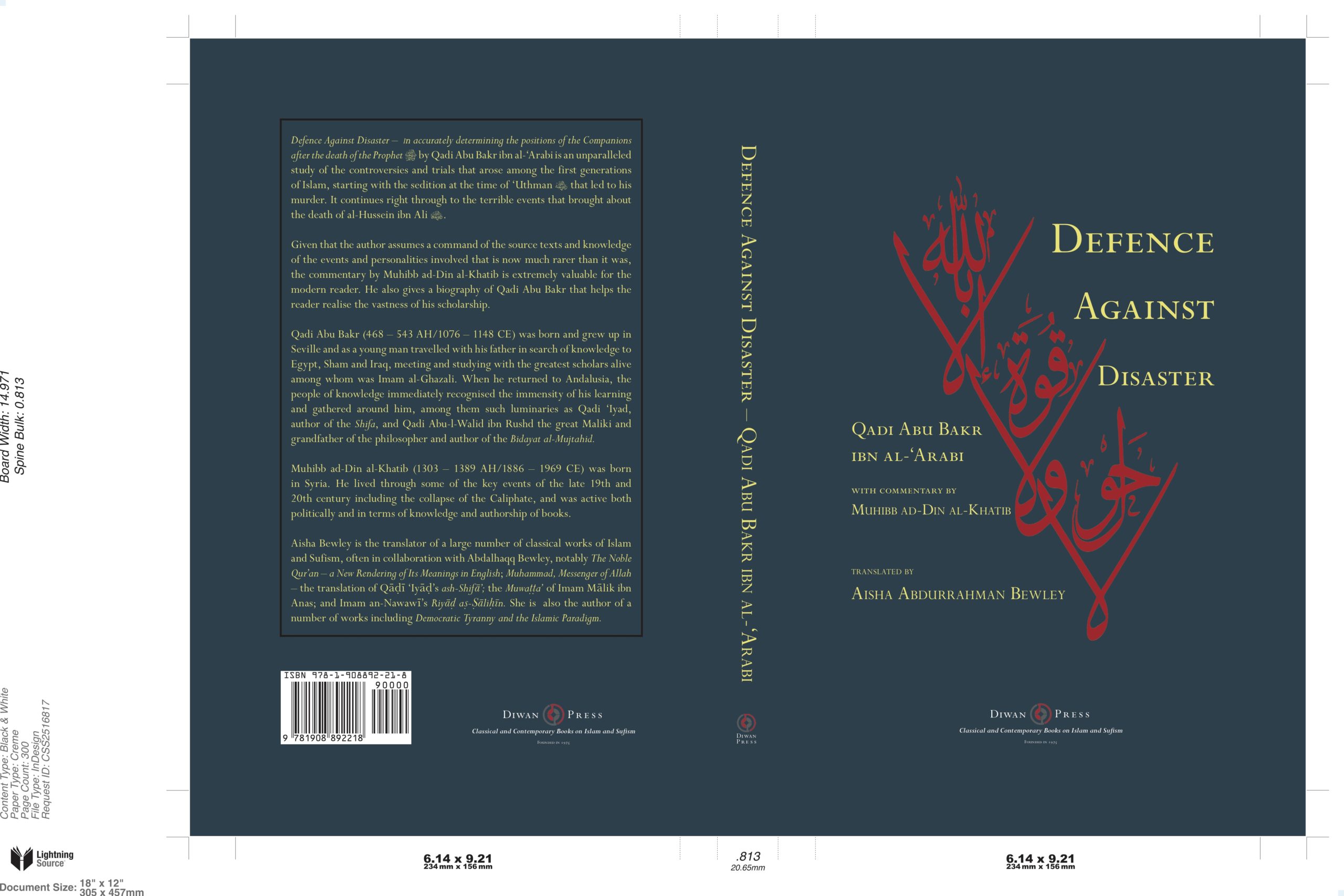
15.6 x 23.4 cm. 324 pages
Qadi Abu Bakr (468 – 543 AH/1076 – 1148 CE) was born and grew up in Seville and as a young man travelled with his father in search of knowledge to Egypt, Sham and Iraq, meeting and studying with the greatest scholars alive among whom was Imam al-Ghazali. When he returned to Andalusia, the people of knowledge immediately recognised the immensity of his learning and gathered around him, among them such luminaries as Qadi ‘Iyad, author of the Shifa, and Qadi Abu-l-Walid ibn Rushd the great Maliki and grandfather of the philosopher and author of the Bidayat al-Mujtahid.
Muhibb ad-Din al-Khatib (1303 – 1389 AH/1886 – 1969 CE) was born in Syria. He lived through some of the key events of the late 19th and 20th century including the collapse of the Caliphate, and was active both politically and in terms of knowledge and authorship of books.
Aisha Bewley is the translator of a large number of classical works of Islam and Sufism, often in collaboration with Abdalhaqq Bewley, notably The Noble Qur’an – a New Rendering of Its Meanings in English; Muhammad, Messenger of Allah – the translation of Qāḍī ‘Iyāḍ’s ash-Shifā’; the Muwaṭṭa’ of Imam Mālik ibn Anas; and Imam an-Nawawī’s Riyāḍ aṣ–Ṣāliḥīn. She is also the author of a number of works including Democratic Tyranny and the Islamic Paradigm.

Reviews
There are no reviews yet.